The short answer
Before buying a non-agricultural (NA) plot in Maharashtra, check four things: the 7/12 extract and 8A account in the seller’s name with a clean encumbrance column; the order or development permission that makes the land non-agricultural; a title search going back about 30 years; and a sanctioned layout that shows your plot. Have an independent property lawyer confirm all four before you pay anything significant.
Why “NA” matters in the first place
Agricultural land in Maharashtra cannot simply be bought by anyone. Section 63 of the Maharashtra Tenancy and Agricultural Lands Act, 1948 makes a sale of agricultural land to a non-agriculturist invalid unless it complies with the Act, which in practice means prior permission from the Collector on specified grounds. For most city buyers looking for a second home, that is why the land has to be non-agricultural before the purchase, not after.
An NA plot is land whose use has been changed from agriculture to a permitted non-agricultural use, such as residential. That change is what lets you build a home on it legally, and it is the first thing a careful buyer verifies.
What changed in the NA rules in 2025–26
The process behind NA status has changed. The Maharashtra Land Revenue Code (Second Amendment) Act, 2025 substituted Section 42 of the Code: where the proposed use is permitted under the applicable development or regional plan, no separate permission from the Collector is needed to change land from agricultural to non-agricultural use. The planning authority can grant development permission or approve building plans directly, and building plan approval is treated as deemed NA clearance.
The annual NA tax has been abolished and replaced by a one-time premium on conversion, calculated on the market value in the Annual Statement of Rates. Two details matter for buyers. Land that was converted earlier must pay its one-time premium within one year at prescribed rates. And building permission alone does not change the classification of Class-II occupancy land, which still carries its own conditions. For the Igatpuri area, the Nashik Metropolitan Region Development Authority (NMRDA), notified in 2018, is the planning and development authority and its region includes Igatpuri taluka.
In practice: ask the seller for the NA order or the development permission the land relies on, and ask whether any one-time premium due on it has been paid.
The checklist
| Document or check | What to look for |
|---|
| 7/12 extract (Satbara) | Seller’s name as occupant; area that matches the plot; encumbrance and other-rights column free of loans or claims; nature of land; latest mutation entry number |
|---|
| 8A extract (Khata) | All survey or gat numbers held under the seller’s account, reconciled with the 7/12 |
|---|
| Mutation entries (Ferfar) | How the seller acquired the land: registered deed, inheritance, court order or something weaker |
|---|
| NA order or development permission | Permitted use is residential; conditions attached; one-time premium paid where applicable |
|---|
| Title search, about 30 years | Registered deeds, mortgages and releases via Index II extracts on IGR e-Search and at the sub-registrar’s office |
|---|
| Sanctioned layout | Approved by the planning authority, with your plot number, roads and open spaces marked |
|---|
| Title certificate | A written opinion from your own advocate, after all of the above |
|---|
Reading the 7/12 properly
The 7/12 combines two village registers: Form VII, which records occupants and rights, and Form XII, which records cultivation and possession. The columns that matter most to a plot buyer are the occupant’s name, the area, the nature of the land and the encumbrance column. Anyone dealing with the land is treated as having notice of what that column records, so a bank charge noted there is your problem if you ignore it.
The extract is a starting point, not proof of title on its own. It is presumptive evidence, and courts generally give a registered sale deed priority over a 7/12 entry. Read it together with the 8A account and the mutation register, which shows each change of ownership and the document behind it. Digitally signed 7/12 extracts from the state’s Mahabhulekh service are accepted as electronic records, so you do not need to rely on a photocopy handed over by a broker.
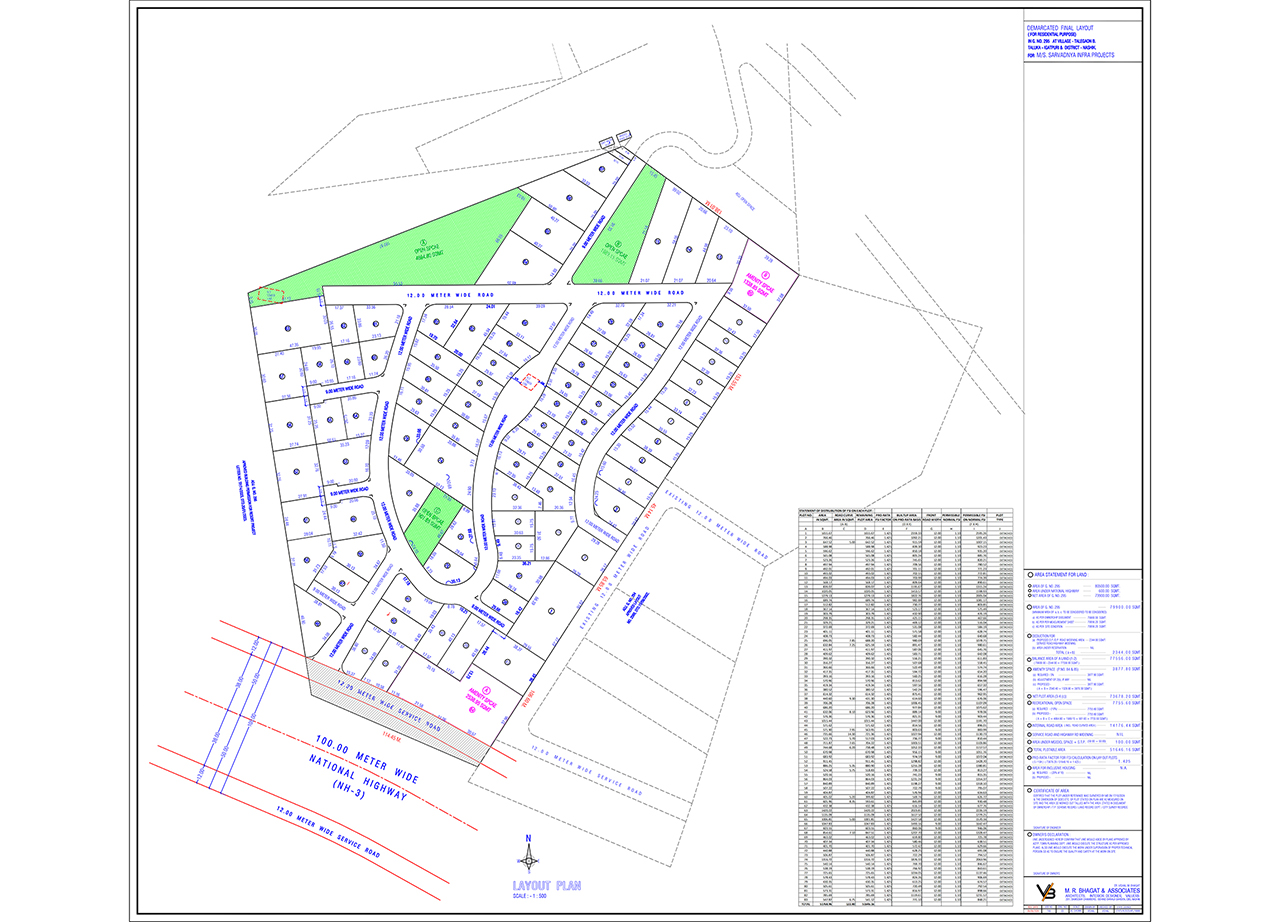
The Fog Cielo master layout.
The title search: why 30 years
The 7/12 shows today’s position. The title search shows how the land got there. Maharashtra’s IGR e-Search lets you look up registered documents by property, and returns Index II extracts summarising each deed’s parties, property and consideration. A common practice is to search back about 30 years for a purchase, using the sub-registrar’s office for years that are not online.
Know the limits. e-Search shows registered history only. Unregistered loans, family arrangements and pending suits will not appear, and the online results are not certified. That is the gap your advocate’s title certificate is meant to close.
The layout: the plot inside the plan
In an estate, you are buying one plot within a larger approved plan. Ask for the sanctioned layout and check that your plot number, its boundaries and the access road appear on it exactly as marketed. Look at what the layout reserves: road widths, open spaces and amenity areas are fixed at approval and shape what the estate will feel like in twenty years. Then visit the site and walk the boundaries against the plan.
How Fog Cielo answers the checklist
Fog Cielo is a gated estate of about 83 NA plots on roughly 20 acres at about 2,100 ft, near Igatpuri. As stated by the developer, each plot has an individual 7/12, NA permission has been obtained and the title is clear. The layout keeps 30% as open space, with 12 m concrete roads and underground electricity. We encourage every buyer to have these documents verified by their own lawyer; the papers are available on request. See title, NA & approvals → NA plots in Igatpuri →
This article is general information, not legal advice. Rules and procedures change; confirm the current position with a qualified advocate before you buy.
Sources
Keep reading